

The Empty Ballot Line
It's the busiest primary day of the year so far. The race that should scare us isn't the one with too many candidates — it's the thousands with too few.

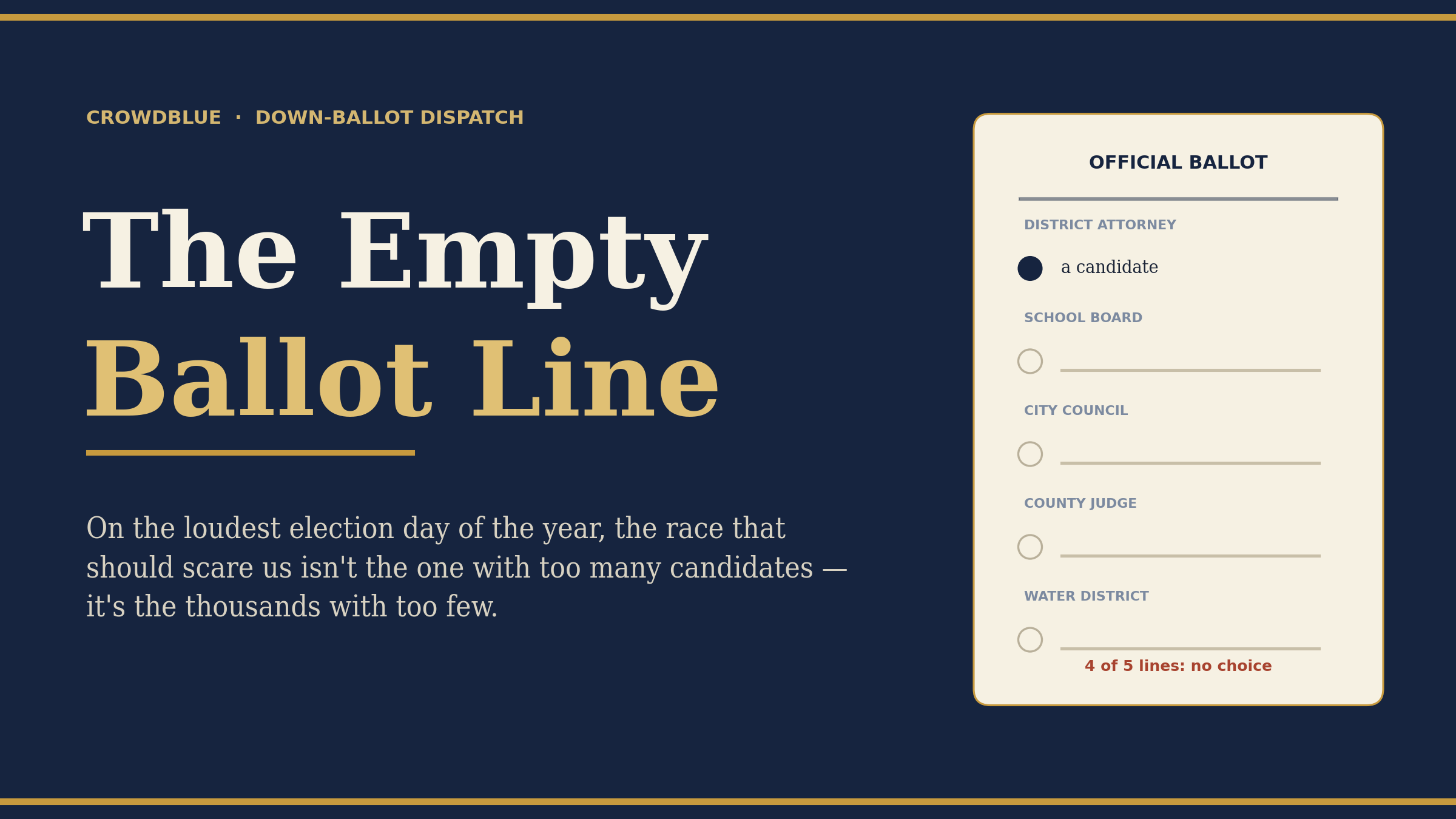
Today is the loudest day on the political calendar so far this cycle. Six states — California, Iowa, Montana, New Jersey, New Mexico, and South Dakota — are holding primaries, the opening salvo of a month that runs through nineteen states plus D.C. The governor’s mansions are open in California and New Mexico. More than sixty names are on the ballot for governor in my own state. There are congressional primaries that will help decide who controls the House in November.
That’s the story everyone is telling. It’s a good story. It’s also a distraction from the one that actually matters.
Because if you want to understand the real condition of American democracy, you don’t look at the race with too many candidates. You look at the ones with none.
The race in my backyard
Let me start close to home, because the local race I know best is also one of the most revealing in the country.
In nearby Alameda County, three people are running for District Attorney. The incumbent, Ursula Jones Dickson, wasn’t elected — she was appointed, after voters recalled Pamela Price in 2024 by a roughly 63–37 margin — the first DA in the county’s history ever to be recalled. Now Price is back, running to reclaim the seat she lost. A third candidate, Gopal Krishan, is pitching himself as the outsider with no prosecutorial baggage at all.
Watch where the money went. The union representing the prosecutors who work inside that office put thirty thousand dollars behind Jones Dickson — the largest single source of her support. The people who would have to work under the winner placed their bet, and it wasn’t on the reformer’s return.
Here’s why a single county prosecutor’s race deserves your attention: one person, decided in a low-salience race most voters skim past on their way to the governor’s contest, sets charging policy for roughly 1.6 million people. That’s the whole argument for paying attention down-ballot, compressed into one office. The DA touches more of your daily life than the governor does, and almost nobody can name theirs.
And Alameda isn’t an outlier — it’s a bellwether. The same 2024 cycle that recalled Price also ended George Gascón’s tenure as DA in Los Angeles. The pendulum on criminal-justice reform is swinging, and it’s swinging one county at a time, in races most national reporters can’t find on a map.
This is not only a California problem
Broaden the lens and the pattern holds everywhere.
In Montana’s 1st District, Ryan Zinke’s retirement opened a seat, and both parties produced real, contested primaries to fill it — a Democratic field running from Ryan Busse, the party’s 2024 gubernatorial nominee, to a firefighter backed by the Sanders–AOC wing, to an education advocate. That is what a healthy pipeline looks like: an open seat, and a line of people willing to fight for it.
In New Mexico’s 2nd District, Gabe Vasquez is defending a seat that came down to less than two points in 2024 — a district where the down-ballot organizing that CrowdBlue exists to power will decide the outcome, not the presidential narrative.
These races make the news precisely because they’re contested. Open seats attract money, talent, and attention. They are the exceptions that proves the rule.
The real story: the empty ballot line
Here is the number that should be on the front page tonight, and never is.
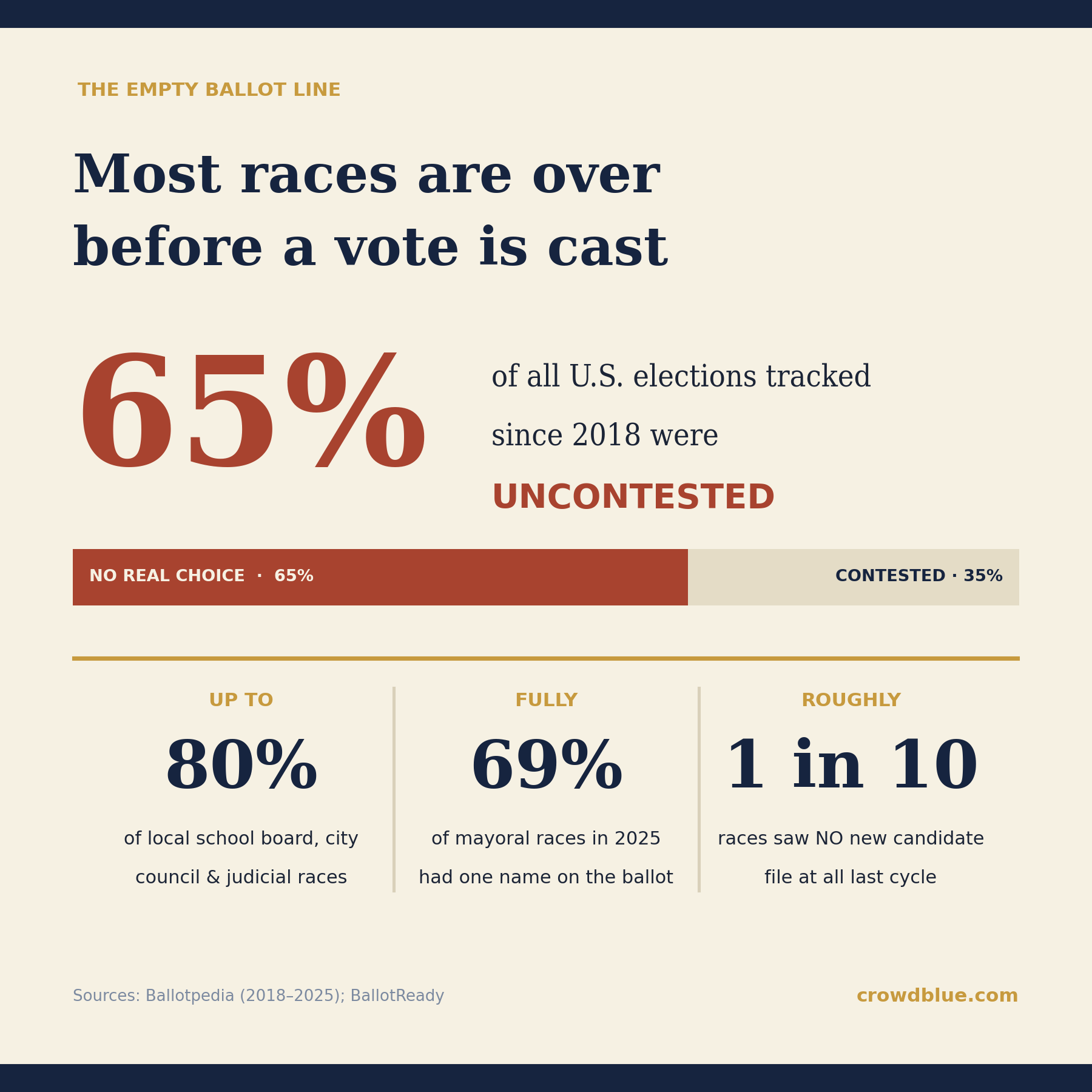
Across all the elections Ballotpedia tracks, an average of 65% have gone uncontested since 2018 — peaking at 70% in 2024. In the November 2025 cycle, of nearly 14,000 races they covered, 60% had no real contest at all. Mayoral races that year? Sixty-nine percent uncontested — more than two out of three American cities held a “race” for mayor with exactly one name on the ballot.
Go further down and it gets worse. BallotReady’s analysis finds that up to 80% of local school board, city council, and judicial races offer voters no real choice. And in roughly one in ten races last cycle, not a single new candidate filed — meaning the election was canceled outright or the seat simply handed over by appointment.
Sit with that. The school board that decides what your kids read. The city council that decides whether your rent goes up. The judge who decides who walks free. In a huge share of these, the “election” is a formality. The winner was decided the day filing closed, because only one person bothered to file.
That’s the empty ballot line. And it is the single largest, most fixable failure in our democracy.
The part that should bother Democrats specifically
One more data point, because it cuts close. In each of the last four cycles, Democrats have contested fewer congressional races than Republicans. We are leaving seats — and the down-ballot offices beneath them — on the table before a single vote is cast.
This is not a messaging problem. It is not a turnout problem. You cannot turn out votes for a candidate who doesn’t exist. It is a recruitment and infrastructure problem, and it is the problem this entire enterprise was built to solve.
The threads, pulled together
If you’re a candidate, an organizer, or someone staring at a local seat wondering whether to run, here is what today’s races are actually telling you:
Your toughest opponent is the empty chair. In most local races, the hardest part isn’t beating someone — it’s being the someone. Filing is not a formality; it’s the single highest-leverage act in down-ballot politics. The day you file in an uncontested race, you have already done more than the 65% who never produced a challenger.
Local offices are where power actually lives — and where it’s cheapest to win it. A DA, a school board seat, a city council seat. These offices govern your daily life and are decided by a fraction of the electorate. The leverage-to-effort ratio is unmatched anywhere else in politics.
Incumbency is strong, not invincible. Of the mayors who sought re-election over the last decade, nearly 17% lost. Challengers win. The myth that you can’t beat a sitting officeholder keeps more people off the ballot than any actual incumbent ever has.
The infrastructure gap is the opportunity. Every uncontested race is a seat the other side gets for free. Flip that framing: every uncontested race is a seat we can contest the moment we have a candidate and the tools to back them.
What we built for exactly this moment
The reason I keep coming back to the empty ballot line is that it maps, almost perfectly, onto the three things a person needs to go from “I’m frustrated” to “I won.”
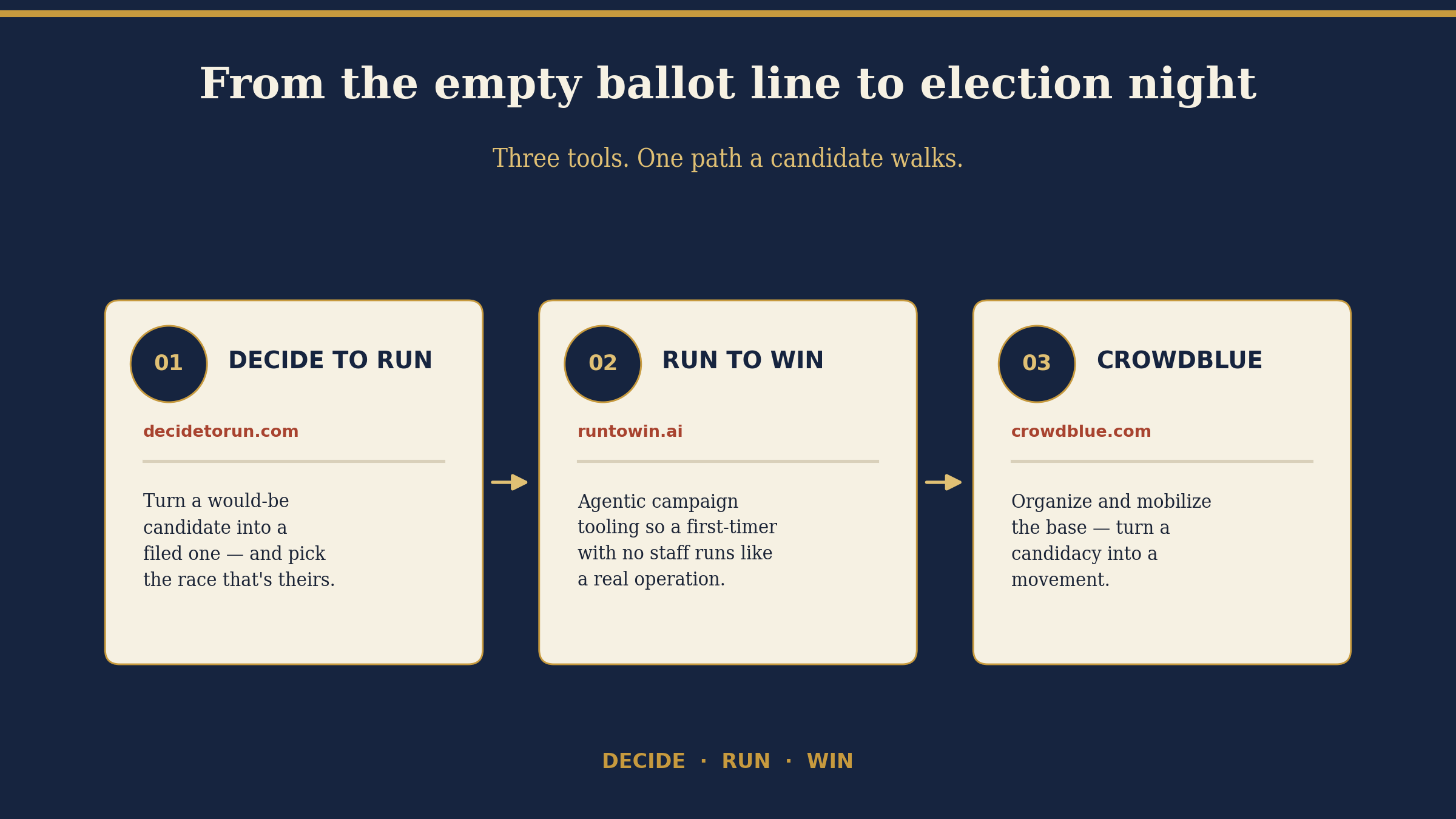
Decide to Run is for the moment before the empty line gets filled — helping people figure out which race is theirs and how to actually get on the ballot. We can’t beat 65% uncontested if we don’t first turn would-be candidates into filed ones.
Run to Win is for the part where you have to actually run — the agentic campaign tooling that lets a first-time candidate with no staff operate like a campaign with twenty. The reason most local races go uncontested isn’t apathy; it’s that running feels impossible without infrastructure. So we built the infrastructure.
CrowdBlue is for the base you organize and mobilize once you’re in — the engine that turns a candidacy into a movement, and a single race into a network.
Decide. Run. Win. It’s not three products; it’s the path a person walks from the empty ballot line to election night. The races that actually run your life are sitting there, uncontested, waiting for someone to file.
Tonight, while everyone watches the governor’s race, go find the one nobody’s running in.
That’s the race that needs you.
If you’re thinking about a local seat — or you know someone who should be — this is the cycle. Start at decidetorun.com.